I Paid $270 for Intel's Most Unhinged CPU
Back in April 2025 I grabbed a Xeon W-3175X off eBay for $270. That’s not a typo.
This thing launched at $2,999. It’s the only consumer-facing 28-core chip Intel ever shipped, and it only worked in a handful of boards — the ASUS ROG Dominus Extreme, the Gigabyte C621 Aorus Xtreme, and the EVGA SR-3 Dark (I’ve actually had two of those). Not a long list. You couldn’t just drop this into any LGA 3647 server board and call it a day — it needed a platform built around its unlocked multiplier and extreme power delivery. One chip, a few very specific boards, one insane platform. And I got the CPU for the price of a mid-range GPU.
It Came From China and It Showed
I knew what I was getting into. The listing was honest — shipped from overseas, no box, cosmetic wear noted. When it showed up I could see why.
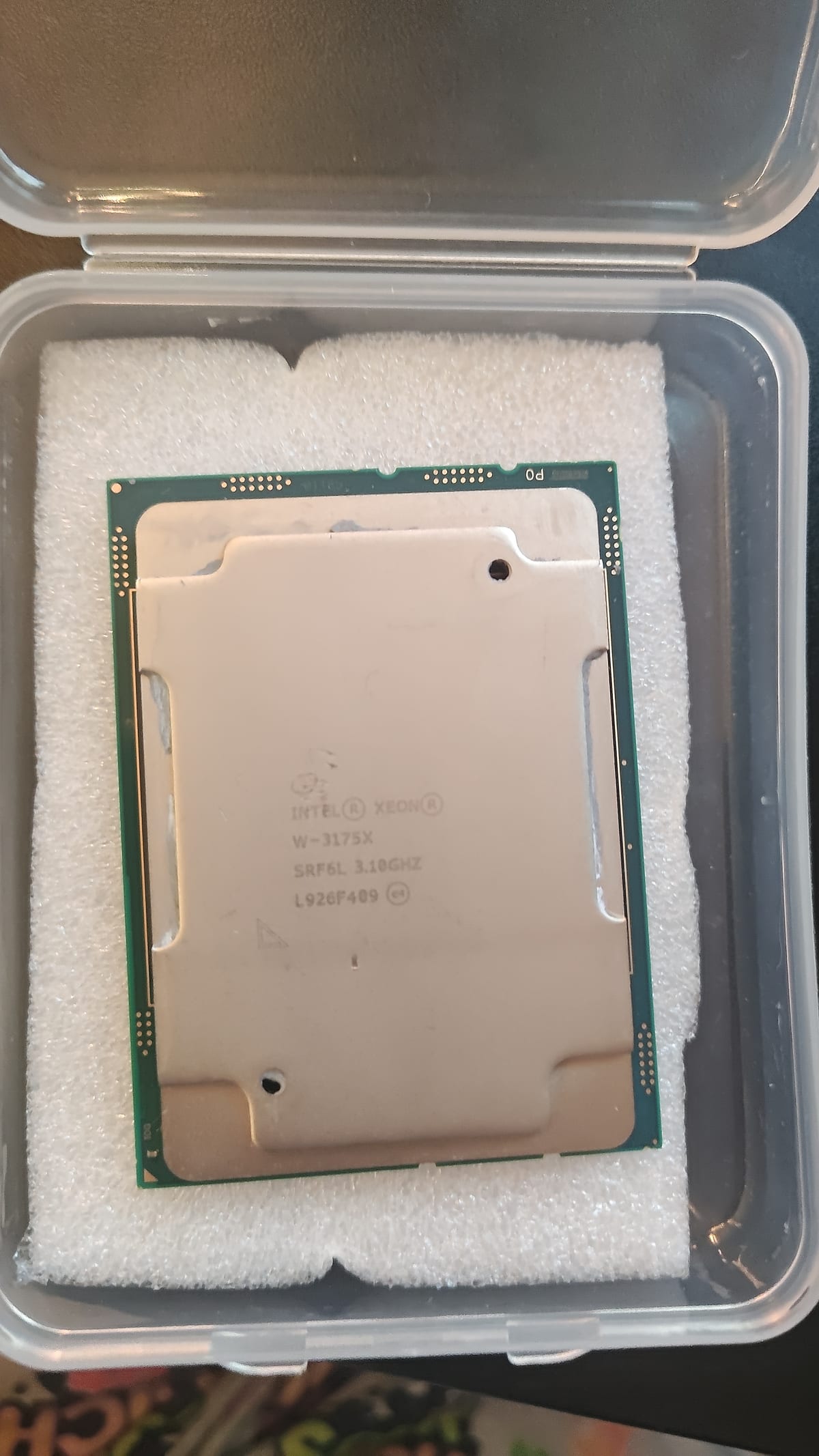
Scratches across the IHS. Thermal paste residue caked on the back of the chip around the LGA pads. This thing had clearly been in a system, pulled out without much care, and shipped across the world in a padded envelope.
But here’s the thing — none of that matters. The IHS is cosmetic. The paste residue cleaned up. What matters is whether the silicon works and whether the IMC trains, and on both counts this chip came in swinging. Dropped it into the Dominus Extreme, populated 6 channels of DDR4, and it posted first try. IMC tested clean. Not a single issue.
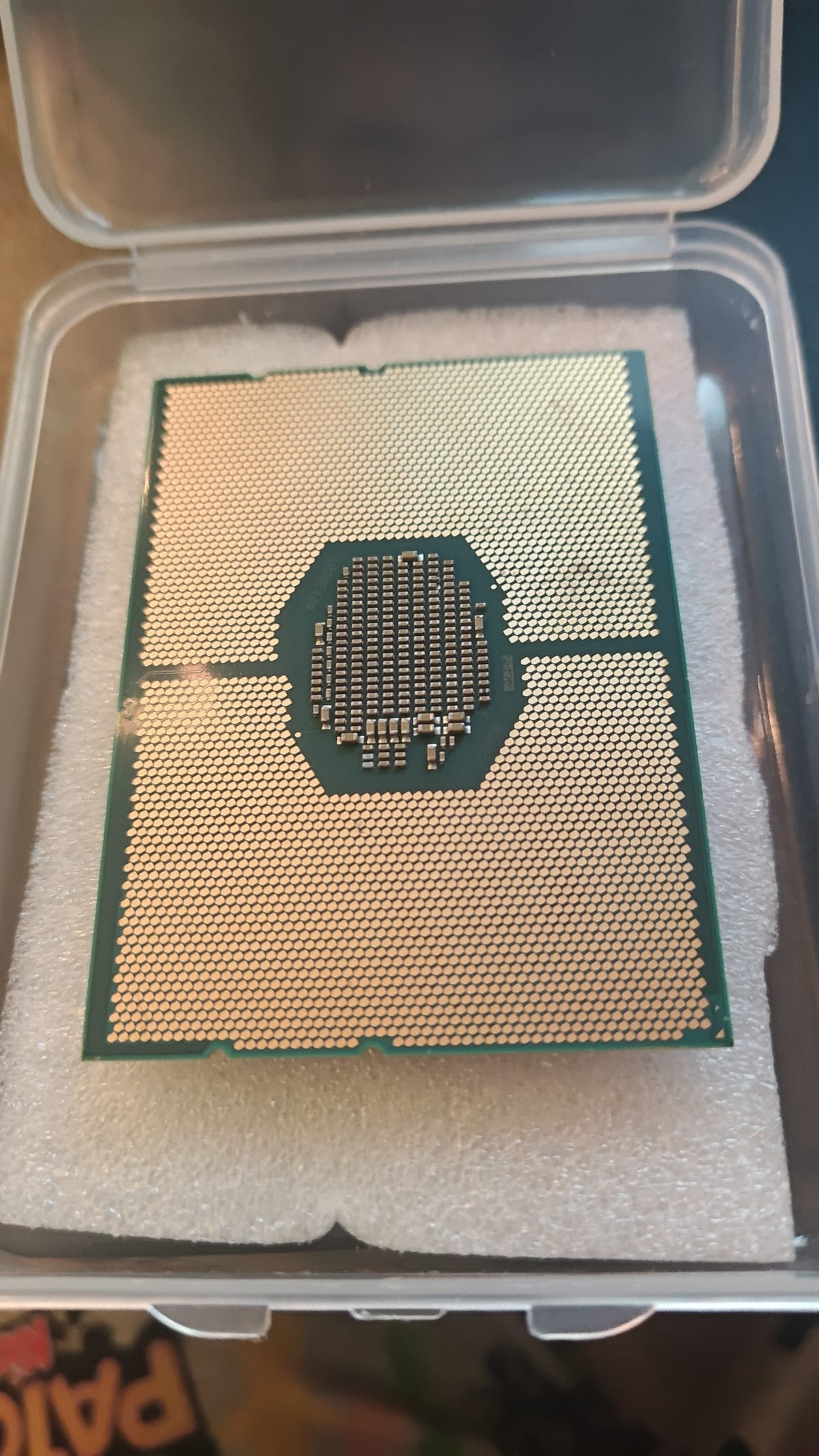
It’s been sitting in that board ever since.
400 Watts. At Stock.
Here’s where this chip gets truly unhinged.
The official TDP is 255W. Which is already a lot. But TDP is a thermal envelope number, not a real power figure — and the W-3175X will absolutely blow past it if you let it. Running all-core loads at stock settings, with no manual power limits, I’ve watched this chip pull 400 watts through the Dominus Extreme’s power delivery.
Four hundred watts. From a single CPU. At stock clocks. No overclocking required.
The Dominus Extreme has the VRM to handle it — ASUS built that board specifically for this chip, and they didn’t cut corners. But it still feels absurd to watch a CPU eat 400W and just keep going. The Noctua cooler on it is working hard. The whole platform runs warm. It doesn’t care.
One of the Biggest Dies Intel Ever Shipped
This is the other thing I love about this chip and not enough people talk about it.
The W-3175X runs Skylake-SP’s XCC die — 28 cores across roughly 694mm² of silicon, about 21.6mm x 32.3mm. I used to think that was Intel maxing out the reticle limit, the physical ceiling on how big a die the fab’s lithography can expose in one shot. It’s not — 14nm’s DUV immersion reticle field tops out around 858mm² (26mm x 33mm), so there was still real headroom left. Intel got close on one dimension (32.3mm of a possible 33mm) but nowhere near it on the other.
So it’s not a lithography ceiling. It’s a yield and cost ceiling — a monolithic die this size is already brutal to produce without defects, and going bigger just tanks yield further for no real benefit to a workstation part. The die is still huge — you can see it when you look at the chip, this massive piece of silicon sitting under the IHS, much larger than anything in a normal consumer CPU. It’s one of the reasons the power draw is what it is, and it’s one of the reasons Intel never made anything quite like it again.
There’s something I find genuinely cool about owning a chip built from one of the largest monolithic dies Intel ever put into a shipping product.
$270 for All of This
I keep coming back to the price. $270 for a 28-core, 56-thread Xeon with an unlocked multiplier, 6-channel DDR4 support, and 48 PCIe lanes. A chip that launched at $3,000, ate 400 watts, and was built from one of the biggest monolithic dies Intel ever shipped.
It’s a terrible practical CPU in 2026. The platform is expensive, power hungry, and loud. There are modern chips that will outperform it in almost every workload.
But that’s not why you get one.
Intel Xeon W-3175X — 28C/56T, LGA 3647, currently living in the ROG Dominus Extreme. Scratched up. Running great. Full details on the finds page.