LGA 3647: Born in a Server Rack, Dropped in a Desktop
LGA 3647 has a weird mounting system. Not weird in a “quirky design decision” way — weird in a “this was built for something completely different and we shipped it anyway” way. To understand why, you have to start with where the socket actually came from.
It’s a Server Socket
LGA 3647 was designed for the Intel Xeon Scalable platform — Skylake-SP, Cascade Lake-SP, the chips that live in 1U server sleds and run 24/7 in data centers. The name tells you everything: 3,647 electrical contacts arranged in a dense hexagonal grid. The package itself is roughly 76mm × 56mm, which is enormous compared to anything you’d normally drop into a consumer desktop.
In that context the whole thing makes complete sense. Server boards are built big, the ILM (Independent Loading Mechanism) is designed to handle the chip in a dense chassis, and the platform is optimized for reliability and serviceability — not consumer ergonomics.
Then Intel decided the W-3175X — a 28-core, unlocked-multiplier Xeon — was going to be their HEDT flagship. And instead of designing a new socket for it, they just used the server one.
The Narrow ILM Problem
Here’s where it gets interesting.
The LGA 3647 ILM uses side clamps. Two arms press in from the left and right and hold the chip against the socket contacts. On a normal consumer CPU — LGA 1700, AM5, anything modern — this works fine, because the die is small relative to the ILM’s clamping width. The pressure from both sides distributes across the entire surface of the chip.
The Xeon die is not small.
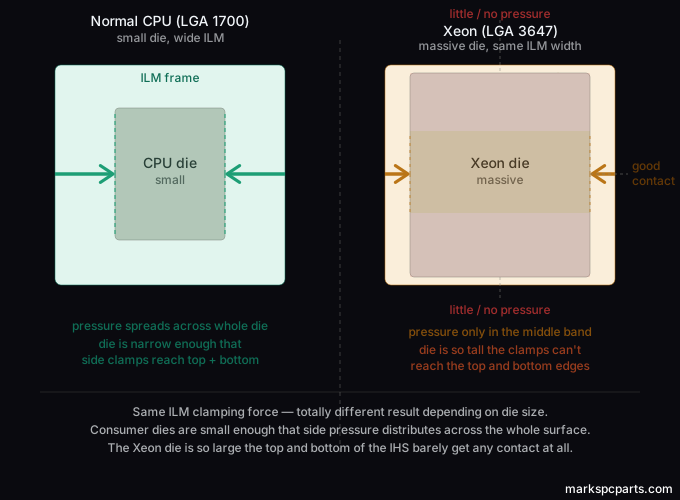
The W-3175X die is enormous — one of the largest monolithic dies Intel ever shipped, roughly 694mm² of silicon. When that goes into an ILM designed around a different workload and a smaller die profile, the clamps press in from the sides and reach the middle of the chip just fine. The top and bottom edges get almost nothing.
This isn’t a theoretical concern. Uneven mounting pressure means uneven thermal contact between the IHS and the cooler. The cores sitting in the well-clamped center band behave differently from the ones near the edges. Your temperature deltas across a 28-core die aren’t just about workload distribution — part of what you’re measuring is contact quality.
You Glue the Chip to the Cooler First
The cooler mounting workflow on LGA 3647 is where things depart most sharply from anything else you’ve worked on.
Normal build, every platform you’ve ever touched: CPU goes in the socket, retention closes, paste goes on, cooler lowers on top, screws go in. Top down. Linear. Simple.
LGA 3647 HEDT with a serious aftermarket cooler or custom water block: the block’s retention hardware has a bracket or clips that physically lock onto the edges of the CPU’s IHS. You apply paste, clip or bolt the block to the chip, and now the cooler and the CPU are a single assembly before either of them has touched the motherboard.
Then you lower that whole sandwich down onto the socket and bolt it through to the backplate.
The chip attaches to the cooler first. It sounds backwards because it is backwards — but it makes sense once you understand the geometry. The ILM holds the CPU into the socket with enough force that the cooler mounting needs to match it, and on a die this large with this kind of heat output, you want the block making full, deliberate contact before it ever has to fight the socket retention for alignment.
The practical consequence of getting this wrong: if you pull the cooler without releasing the retention properly, you’re lifting the CPU out of the socket along with it. Pull hard enough or at the wrong angle and you’re bending contacts. It has happened. It will happen again to someone. The fix is knowing the order before you start.
Server DNA, Desktop Box
None of this is a design flaw in the context LGA 3647 was actually built for. In a 1U server sled, the ILM works exactly as intended. The pressure distribution is fine for chips running steady-state enterprise workloads. The cooler mounting is designed for a service technician swapping parts in a rack, not a hobbyist building a custom loop.
Intel took that socket, handed it to three boutique board partners — ASUS for the ROG Dominus Extreme, EVGA for the SR-3 Dark, and Gigabyte for the C621 Aorus Xtreme — told them to build something for the W-3175X, and called the result an enthusiast platform. The boards are genuinely impressive. The chip is genuinely impressive. But the socket underneath all of it was never designed for a desk, and it shows the moment you try to cool it like one.
That’s what makes the platform interesting to work on. Every quirk has a reason. The reason is just usually “because servers.”
W-3175X + ROG Dominus Extreme — running, watercooled, the cooler was attached to the chip before the chip hit the board.